A New Era by Beth Kennett and Charity Roberson
About 2 weeks ago, we learned there were some issues with the building that has served the offices for the Center for Congregational Health and, since 2020, has served as a storage space, an occasional meeting space, and an occasional office space. 1920 Queen St. was the home of the Center for Congregational Health for more than 30 years. If you search for us online, it is the physical location that pops up.
Last week, when I became concerned, we might be told to move out quickly, I made the decision to move our stored items to another newer building where the CareNet offices are. As I was moving those boxes, I reflected on the meetings and conversations with Dave Odom, Les Robinson, Chris Gambill, Bill Wilson, Dawn Hall and Robin Danner; the lunches shared in the conference room, the trainings that took place in the building, and mainly the relationships that have grown over the past 34 years. I didn’t feel an emotional attachment to the building, and I celebrated the relationships that had an opportunity to begin in that space.
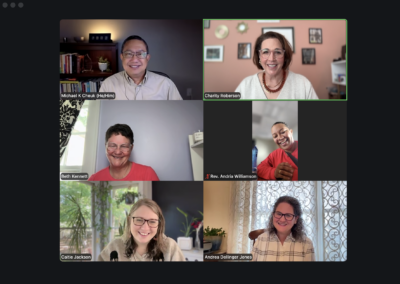
After moving those boxes, I felt lighter as if I had let go of something that no longer served us well. Over the past week, I have felt a shift. In the past few years, Charity Roberson has joined our staff full-time, we have part-time contract staff, Caitie Jackson, Michael Cheuk, Andrea Dellinger Jones and Abby Washington; we are exploring the possibility of having a Doctoral Fellow (Andria Williamson); we are more integrated in the Division of FaithHealth, and we have a growing number of partners in the work we do.
We have not operated within one building since before 2020. And while it does create some challenges to move out of it, it also has its benefits.
We have staff currently in three states. Those of us within one state, are at least two hours apart. Not being tied to one space allows us to include the best people who are not tied to one location. It gives us a footprint in more key areas.
We do not have to worry about the typical concerns of a building. In this instance, we do not have to solve the asbestos problem in our former building.
Not being tied to one building allows us to do trainings and participate in events in a much broader area.
Our mission has not changed, just the way we do our work. We have to be more intentional about collaboration and about the flow of our work. We make the most of the times that we are in the same spaces. We have found creative places to meet in person when we need it, including the food court of a mall before the mall opens.
We know that many congregations are facing decisions about their staff and their buildings. Do they need to live full time in the area where they are pastoring? Do we need and can we support a full-time minister? Can we keep our building if we cannot afford to heat and cool it or afford to make the necessary repairs? Congregations in towns that are getting smaller must begin thinking about a broader radius for membership.
Thirty-four years ago, when The Center for Congregational Health was founded, the leaders could never have imagined our working realities of today. It would not have even been possible. As we seek to find new ways forward in these new times, we walk alongside congregations doing the same. Congregations are facing new challenges, but they also have new opportunities. If we can help your congregation find new ways forward, please contact us.